Friday, July 31, 2015

1887: King Leopold II Worries About The Future Of Belgium And Europe


The World's Sovereigns 1889 (photomontage)
The one in the center is Kaiser Wilhelm I of Germany, seated to his left on a chair is Queen Victoria.
King Leopold II of Belgium is the second man on his right (long dark beard), while the two men standing right next to him are; Left: Emperor Franz Joseph I of Austria; Right: Tsar Aleksandr III
While in London in 1887 to attend the celebrations for his cousin Queen Victoria’s 50 years of reign, Belgium’s second King, Leopold II (who later became infamous for his role in the Congo massacre), wrote the following to his chief of state:
King Leopold II

Europe’s political future remains rather uncertain […]. If we wish to remain independent, we need to strengthen ourselves and prove ourselves worthy of our independence.

As you can tell, he was already quite worried about what was fomenting behind the curtains within Europe’s highest political spheres.

Upon his return, King Leopold II desired to have a true Belgian army raised instead of their current conscription system which mainly allowed richer folks to pay poorer ones to take their spot in this army. Unfortunately, these changes were voted down by the Chamber of Ministers in July.

So the King decides to play a little game: pretend that he doesn’t want to uphold his obligations (such as attending an important party in Bruges in August) to show his displeasure with his government, then finally accede to their entreaties upon the condition that they let him hold a speech (WARNING: it is quite a long read). The maneuver works, and on August 15, 1887, King Leopold II says the following to a large crowd:

Monday, July 20, 2015

Happy Birthday Belgium!

Tomorrow, July 21, will be the celebration of Belgium's first step towards independence, aka the beginning of its revolution (which started with a Broadway-like play, if you will).

185 years of independence (discounting the years of occupation, of course). It's rather young for an "Old World" country, but that's one of the things that makes Belgium so interesting, isn't it?

In any case, I'm reading this great book that was published in 1930 by the Editions illustrées du "SOIR" Bruxelles published in celebration of Belgium's 100 year anniversary (ah, how I love history!). And in its first pages, I found this great genealogical tree of the Royal Family which I thought I'd share with you here (notice how beautiful Princess Astrid was, so beautiful and such a tragic fate after the publication of this book).

PS: Apologies for the crookedness of the picture...

Thursday, June 18, 2015

Three Fun Facts About The Battle Of Waterloo

The Battle of Waterloo
Two hundred years ago, this day, the Emperor Napoleon suffered a devastating loss against the Anglo-Prussio-Dutch-Hanoverian-Nassau-Brunswick armies (quite a mouthful, eh? But Napoleon wasn't a favorite among  non-French people...not that he was always a favorite amongst the French themselves either). The battle took place in Waterloo, a town just south of Brussels, in the then United Kingdom of the Netherlands.


In any case, I have a friend who's worked for a number of years at the Wellington Museum in Waterloo who knows quite a few interesting tidbits about the battle itself, and related facts. So, without further ado, here they are:

Monday, May 25, 2015

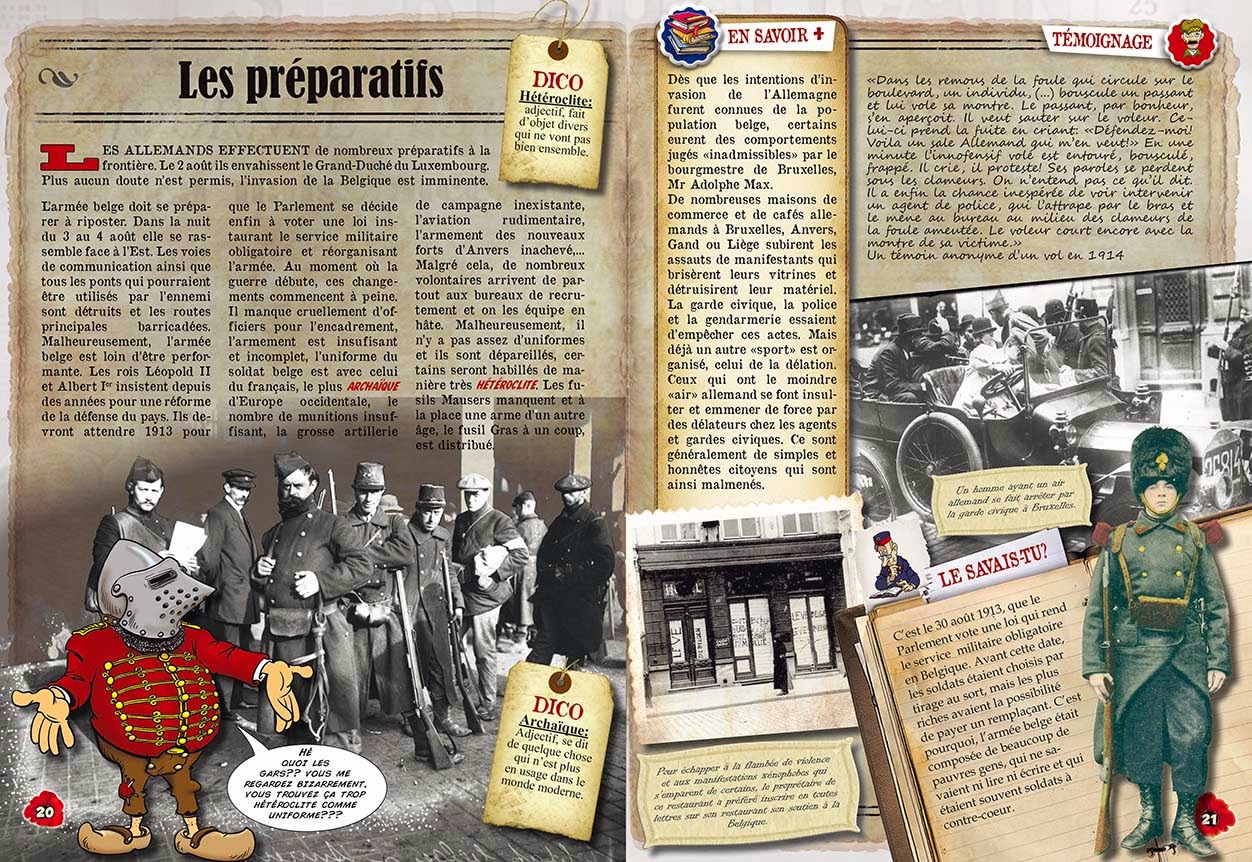
Once Upon A Time... 14-18 Belgium At War


Someone just lent me this amazing little book--half comic-strip, half history book--that I definitely recommend anyone read (it's only in French though):

Il était une fois 14-18 La Belgique en guerre.

It's the loving work of artist and author David P.who spent countless hours combing through the Army Museum of Brussels and flea markets to find all the amazing pictures strewn throughout the pages. Not only that, but the booklet contains also many testimonials left in books and journals, quotes, notes of reference, and other little tidbits, all while also giving information on the war itself, what lead to it and its consequences, in palatable yet juicy morsels.

Belgium, of course, was supposed to remain neutral during what turned out to be a terrible war that marred everyone's psyche. But even so, Belgium was such a small country, known for being a "friendly nation unlikely to harbor great sentimental impulses, inhabited by patient and obstinate workers, skilled artisans, robust farmers, and enterprising bourgeois all comfortably asleep on their pillow of obligatory and guaranteed neutrality while finding any warlike fracas repugnant," that no one, not even its own citizens, expected it to rise so heroically and determinedly against the invaders.

Again, this is a must-read for anyone interested in history, and that of the First World War in particular! (And, of course, for those willing to read it in French...) The book can be found on the editor's website here.


Quote taken (and translated from French) from the Preface of the book written by Professor Francis Balace, University of Liège.

Wednesday, April 29, 2015

The Belgian Popes


From 1789 to 1929, the hamlet of Lodomez, near Luxembourg, has had its own pope.

It all happened because of the French revolution (1789-1799), which on top of having a number of noble heads rolling had also taken upon itself to de-Christianize the country. But despite the reign of terror imposed by the revolutionaries, many kept their faith. And in Lodomez, it is the farmer Antoine Hurdebise who took over for the exiled ecclesiastics, assembling everyone for prayer, baptizing newborns and giving the last sacraments, and that despite the new edicts forbidding it. It is therefore no surprise that the abandoned parishioners started calling Hurdebise "le pape."

Friday, April 24, 2015

The Palace Of Justice


May the expenditures be as large as possible, so that the palace will be worthy of its purpose and its city. ~Jule Anspach.

Sitting upon its hill overlooking a wide span of Brussels, including the basilica of Koekelberg and the Atomium (more on those later), is the Palais de Justice which was started in 1866 and inaugurated in 1883. A propitious hill for its purpose, I suppose, considering the Galgenberg hill was where convicted criminals were hanged back during the Middle Ages.

The Greco-Roman style is evident everywhere you go.
Source

The architect Poelaert
The Palace of Justice is the Greco-Roman style creation of one free-mason Joseph Poelaert, and cost an astounding 46.45 million Belgian francs to build (about 5 times its initial budget), which is only normal when you're talking about the biggest building constructed in the 19th century! The building of this behemoth required the relocation of over a hundred inhabitants of the Quartier des Marolles, and despite the compensation received, people weren't happy with it. Which is why the word "architect" became one of the worst insults possible one could bandy about Brussels at the time.

Thursday, April 16, 2015

Leopold I In Animation

Just found out that this cool Belgian animation team at Mad Cat Studio is putting together a 26-minute long humorous (yet historical) cartoon based on Belgium's creation and its first king!


True facts, you say? That is right. Like the fact that the Belgian "army" had no true weapons to fight the Dutch army seeking to regain its lost territory (see here for a little more on Holland's previous role)--a minor detail the ministers had forgotten to take into account, apparently!

For those of you interested in giving this awesome project a hand, here's their crowdfunding site:
Leopold roi des belges