Monday, May 25, 2015
Once Upon A Time... 14-18 Belgium At War
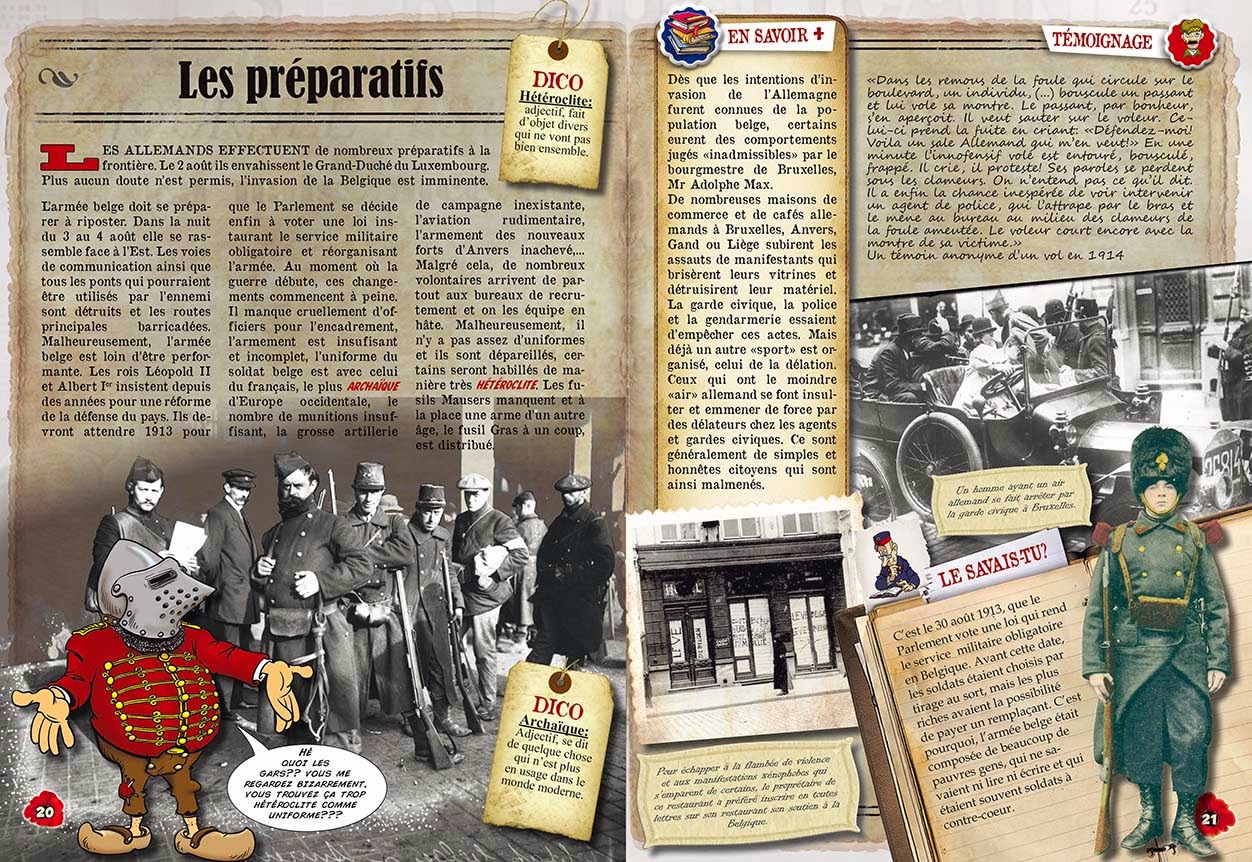
Someone just lent me this amazing little book--half comic-strip, half history book--that I definitely recommend anyone read (it's only in French though):
Il était une fois 14-18 La Belgique en guerre.
It's the loving work of artist and author David P.who spent countless hours combing through the Army Museum of Brussels and flea markets to find all the amazing pictures strewn throughout the pages. Not only that, but the booklet contains also many testimonials left in books and journals, quotes, notes of reference, and other little tidbits, all while also giving information on the war itself, what lead to it and its consequences, in palatable yet juicy morsels.
Belgium, of course, was supposed to remain neutral during what turned out to be a terrible war that marred everyone's psyche. But even so, Belgium was such a small country, known for being a "friendly nation unlikely to harbor great sentimental impulses, inhabited by patient and obstinate workers, skilled artisans, robust farmers, and enterprising bourgeois all comfortably asleep on their pillow of obligatory and guaranteed neutrality while finding any warlike fracas repugnant," that no one, not even its own citizens, expected it to rise so heroically and determinedly against the invaders.
Again, this is a must-read for anyone interested in history, and that of the First World War in particular! (And, of course, for those willing to read it in French...) The book can be found on the editor's website here.
Quote taken (and translated from French) from the Preface of the book written by Professor Francis Balace, University of Liège.
Wednesday, April 29, 2015
The Belgian Popes
From 1789 to 1929, the hamlet of Lodomez, near Luxembourg, has had its own pope.
It all happened because of the French revolution (1789-1799), which on top of having a number of noble heads rolling had also taken upon itself to de-Christianize the country. But despite the reign of terror imposed by the revolutionaries, many kept their faith. And in Lodomez, it is the farmer Antoine Hurdebise who took over for the exiled ecclesiastics, assembling everyone for prayer, baptizing newborns and giving the last sacraments, and that despite the new edicts forbidding it. It is therefore no surprise that the abandoned parishioners started calling Hurdebise "le pape."
Friday, April 24, 2015
The Palace Of Justice
May the expenditures be as large as possible, so that the palace will be worthy of its purpose and its city. ~Jule Anspach.
Sitting upon its hill overlooking a wide span of Brussels, including the basilica of Koekelberg and the Atomium (more on those later), is the Palais de Justice which was started in 1866 and inaugurated in 1883. A propitious hill for its purpose, I suppose, considering the Galgenberg hill was where convicted criminals were hanged back during the Middle Ages.
![]() |
| The Greco-Roman style is evident everywhere you go. Source |
![]() |
| The architect Poelaert |
Thursday, April 16, 2015
Leopold I In Animation
Just found out that this cool Belgian animation team at Mad Cat Studio is putting together a 26-minute long humorous (yet historical) cartoon based on Belgium's creation and its first king!
True facts, you say? That is right. Like the fact that the Belgian "army" had no true weapons to fight the Dutch army seeking to regain its lost territory (see here for a little more on Holland's previous role)--a minor detail the ministers had forgotten to take into account, apparently!
For those of you interested in giving this awesome project a hand, here's their crowdfunding site:
Leopold roi des belges
Tuesday, April 7, 2015
Leaders Of The Belgian Revolution
The territory that now encompasses Belgium saw itself pass between different hands quite a lot before its fight for independence started in mid-1830, mostly those of the French, Spanish (Hapsburgs) and Dutch. In fact, between 1794 and 1814, it had been part of the French Empire, before Napoleon lost his war and Belgium became part of the Southern Netherlands.
One of the reasons why so many people speak French in Belgium nowadays is due to this fact, as Napoleon's government installed many of its citizens in key civic positions around Dutch-speaking Flanders, Brabant and Limburg (it's also a reason why so many of the upper and middle classes at the time were also French-speaking).
![]() |
| Once Belgium was integrated into the French Empire, the industrial revolution reached Belgium, and the first steam-powered engines were clandestinely introduced into the country. Other important changes introduced by Napoleon's reign: new judicial framework on civil rights (foundation for the future Belgian civil code); Wallonia became the most industrialized region of Europe; the port of Antwerp becomes extra-profitable; obligatory military service; zero political freedom; the use of Dutch is repressed in Flanders and nothing can be printed in that language either. (Source) |
In any case, some French immigrants ended up at the head of the Belgian revolution, namely Charles Rogier, the Comte Félix de Mérode, and Alexandre Gendebien. So who were these men?
Thursday, January 29, 2015
When Holland Had Two Capitals
I know, this is a blog about Belgium (and Europe, by extension), so why devote a post to Holland? Well, it turns out that Belgium used to be part of the Netherlands, before Belgium became its own country.
The first king of the Netherlands, King Willem Frederick I, after the northern and southern parts of that country were united. The new king had wanted to have only one capital at the time, Brussels, as he had a predilection for the Southern part of his country (as evidenced by his serious investments in that area--see below). But the Powers that Be (previously mentioned in The Birth And Evolution Of An Artificial State) decided otherwise, and so the Netherlands had two heads of state for a while: Brussels and The Hague.
As a result, the Dutch Parliament had to travel "from one capital to the other, as did 600 families o functionaries and the diplomatic corp. Moving back and forth cost a lot of money, and much energy and time was lost transporting archives."
The first king of the Netherlands, King Willem Frederick I, after the northern and southern parts of that country were united. The new king had wanted to have only one capital at the time, Brussels, as he had a predilection for the Southern part of his country (as evidenced by his serious investments in that area--see below). But the Powers that Be (previously mentioned in The Birth And Evolution Of An Artificial State) decided otherwise, and so the Netherlands had two heads of state for a while: Brussels and The Hague.
As a result, the Dutch Parliament had to travel "from one capital to the other, as did 600 families o functionaries and the diplomatic corp. Moving back and forth cost a lot of money, and much energy and time was lost transporting archives."Monday, January 19, 2015
King Leopold, The Lady-Killer
Before becoming Belgium's first king, Prince Leopold spent some time at Napoleon's court, where his good looks made him a favorite with none other than the Empress Joséphine de Beauharnais, and her sister Hortense (married to Napoleon's brother Louis), among many others.
Not only that, but Leopold was later remember by Napoleon, during the latter's exile at Saint Helena, as "the most beautiful man [he] ever saw at the Tuileries palace."
And that was before he turned 20!
Not only that, but Leopold was later remember by Napoleon, during the latter's exile at Saint Helena, as "the most beautiful man [he] ever saw at the Tuileries palace."
![]() |
| Josephine and Hortense de Beauharnais |
Subscribe to:
Posts (Atom)


